Friday, 4 October 2013

I'm Back....

Soooo, back to Leicester! I'm glad to be back! I mean I love being at home, I love seeing my family and friends, but I've been struggling without some sort of routine. This summer has consisted mainly of me hesitating to leave Leicester (I stayed in my halls until the 22nd of July, due to work), going on holiday for two weeks, then having a month at home where I felt somewhat at a loose end as to what to do with myself.

I had planned to do a bit of a mini group project with a few of my class mates. Before leaving to go home we had decided our project, put together some mood boards, started concepting and white boxing a little tavern scene. Somehow, although I am not surprised at myself, nothing much really came of it. I did some concepts but I never really got much further past that stage. I feel a bit bad for not chasing it up, but on the other hand I found myself getting quite a lot into my digital painting. While I was in Spain for those two weeks, I found myself dying to do some work, whether that was modelling or painting. I put the main reasoning down to the fact that the place I was staying was so beautiful.

Some Summer work....


We stayed in a little village called Frigiliana. It is situated in the hills and the buildings have red tile roofs and white bricks, the pavements are all cobbled in swirly patterns, very idealistic. But, another factor is that when I go on holiday with my parents they don’t like to do much apart from sit around the garden area and read books all day. This is all well and good and I appreciate relaxing for a short amount of time, but when it was getting on the 6 day mark and we were doing exactly the same thing that the days started dragging. As I mentioned before one of the main thing I established last year was that I am pretty crap at doing nothing, after being used to the constant list of things I need to do for uni, having absolutely nothing to do was an alien concept to me.


Me, Ben and Anna all got back right at the beginning of September so, after moving into our new houses (which are super awesome) we were excited to get back to the uni timetable and start doing some work.
This year I am super excited to start the character project and the group project. I think I am looking forward to being given a little more freedom on our briefs, with us having larger budgets and more artistic choices. I am mainly hoping to improve on my speed of work and managed to get more personal projects in on the side.
I have come to the realisation that the amount of work we do for the course, isn't even close to the amount we need to be doing if we realistically want a job when we graduate.  Also this is the year that we will be applying for internships, so it is very important to start putting a portfolio together as we will need them to apply.

I am excited about this year, but also very very scared. I kind of feel like I can see the scale of things a little clearer now, and that mountain I thought I had climbed last year was merely a small hill.

Saturday, 25 May 2013

Year 1 Review...


This year has gone stupidly fast. It does not feel like we’ve been here for a whole academic year already, not to mention our course is somewhat longer than everybody else’s. I mean, we had weeks left before hand in and my flat mates had already started moving out. I’m not ready for this year to end. I need more stuff to do, this year one of my main discoveries is that I’m terrible at doing nothing.

In fact, a lot has changed this year. If you met me this time a year ago, I would have been a very different person. I defiantly had a bad attitude to my work.  I will admit, at A level I definitely could have tried a hell of a lot harder.  I complain about the low mark I got, but looking back, I’m not surprised.  Since getting here I have found something that I actually care about, I’m being challenged, I can actually see myself improving, and it’s completely refreshing. I think my main issue with my A levels was that I had been doing exactly the same thing for the last 4-5 years. I never really left my comfort zone. I studied two art subjects, media studies and philosophy. To be honest I found philosophy the best as I was learning something new.

I mean it wasn’t until the last minute I decided to take the risk and go for this course I was intending on keeping on with the illustration and fine art path. I am so happy I decided against it. If I was doing illustration or fine art right now I don’t think I would have improved much. I certainly would have the same attitude towards it and right now I would probably be over the moon that I had finished.
The difference is; I chose game art. I am currently devastated that I have finished and I want more work to do. My routine has drastically changed this year, I was always accused of being lazy, lying in for ages, but simply I didn’t have something I wanted to get up for. I have become so much more self-motivated.  I’m now up bright and early every day and working until late, because I’m doing something that I love!  
So, how have I improved, and where the most. I guess for the majority of people on the course 3D is going to be where the most improvement lies. I mean, we arrive here all mostly all complete noobs, never having encountered 3D modelling before, and then are chucked straight in with no knowledge on the subject what so ever.

Well lets look back, where is my most atrocious 3D modelling crime to date?
Well this bin is somewhat shameful. I mean the render is hilarious for a start, although not as bad as some of my others with wonderful multi-coloured backgrounds. It wasn’t until after chatting to some third years that I got to grips with doing a decent render.  Looking back at the topology, well, blimey, I was still at that stage where I hadn’t understood that it was ok to have more than one object attached together, as opposed to having one single object.  Ngons galore! I guess as it was one of our very first projects it isn’t completely shameful as we were (and still are) on that huge learning curve.  

A project I was particularly proud of and feel shows a lot of development in my skill, was when we got to the Gladiator project. This was only the term after the wheelie bin, but I already felt much more comfortable with modelling. I had a good understanding of topology, I had moved on to more advanced processes like baking ambient occulsions, zsculpting and baking normal. Not to mention my renders improved drastically.  
When I started the course I didn’t think I would ever be able to make something like this.


I have also been working on my zsculpting, which has helped me practice my anatomy and technical skills in baking in max.  (High poly vs. Low poly bake)

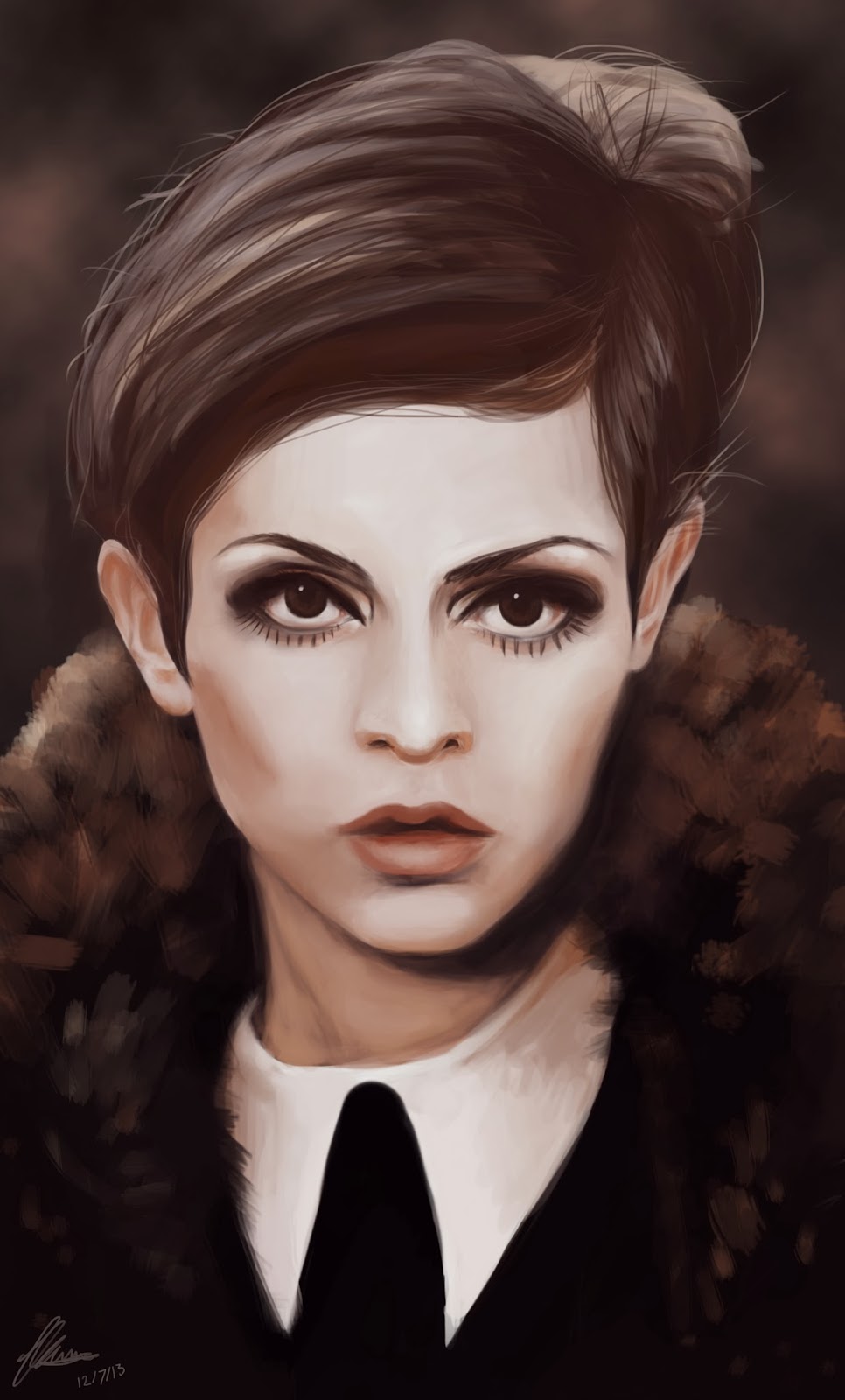
For visual design I feel that I learnt the most in the first term. It was very helpful going back to basics and mastering them,  it has certainly helped me improve overall. I terms of my traditional work I have improved a decent amount, but in my digital work, I feel I have improved rather a lot.


Well this is the first piece of digital work I attempted before coming here in September…


I mean wow, like wow, what?? What is this?? This is true chamber of horrors material, please forgive me Mike. I swear I could at least draw the human figure better, changing from traditional media to digital is somewhat challenging. I think the idea was to learn to achieve tone; obviously this didn’t work so well.


Here are some of my recent pieces...


I feel that I have improved vastly. Life drawing has seriously helped me with my human anatomy, and doing the masters study and other exercises with Chris has helped me to get a better grasp of colour theory.

I have really enjoyed all aspects of the course so far, I’m very pleased that I decided to come here.  My main downfall has unfortunately been this blog. I’m a person that really struggles to get words down. Ask me about stuff in person and I can talk about things for ages. I have also never been someone to get into the habit of regularly writing diaries. My main aim for next year and summer is to get into the habit of this, start writing more about what I’m doing, what I think about it and more often. 
I will be better at blogging, I will be better at blogging, I will be better at blogging... 
I even considered doing video blogs as I am a much more confident speaker, especially after all the presentations we have done this year.  They have seriously boosted my confidence in talking in front of people about subjects that effect, are important or interest me.  I saw a drastic improvement from my first presentation to the final one (my mark also reflected this.)

Over all I feel I have had one of the most successful years in my academic career, I have learnt so much and my attitude to my work has changed drastically. I feel a lot more confident with what I want to do in life and how to go about achieving it. I love my course and all the amazing people I have met here.

Also, Adventure Time rules.

Friday, 8 March 2013

Game Design Part 3 - Characters


The next element of game design I will discuss is Character design. For me Characters are one of the most important elements of games, certainly my favourite part in terms of design. The characters help to make the narrative move and create depth in the story.
It’s easy to answer, ‘what is character design?’ a more relevant question would be ‘what is GOOD character design?’
More and more game developers are realising that just having an aesthetically pleasing character is not enough to keep a gamers interest, the main aspect that makes a good character is depth, little elements to their design and narrative that make the gamer develop a personal relationship to the character.
It is important to look at characters in other media like film and TV. How do they construct a interesting character that the audience can relate to. There are many examples, as film and TV concentrates so much more on the back story and look (to an extent) of a character, which seems to be more and more the case in games.


Let’s take the character Joffrey Baratheon from the book and TV series Game of Thrones, his whole persona makes you instantly dislike him (well watching the series, this was the case for me.) I think that this is accomplished by his looks and acts through the series. Firstly his clothing is dark and with rich colours which connote that he is from a rich family. His sharp features make him seem cruel and the way the crown doesn’t sit properly on his head makes him seem out of place as king. Conventionally a king is big and strong, not small and weedy like Joffrey’s character which all the more just adds to the fact that he must be a cruel and sinister character. As the series progresses his acts and characteristics show his character all the more and reveal his back story, maybe offering an explanation to his cruel deeds. This makes the audience feel like they understand him more and maybe connect with him.
Although this character is a ‘bad guy’ it is still an example of good character design, the look and person of him adds strength and depth to him.

How is this now more often applied in games?


Dragon Age Origins bases a lot of the gameplay on developing character relationships and focus’ a lot of narrative. The character Morrigan is one of the first companions you gain in the game, she is so likeable because of her personality. Again similarly to how the character is set up in Game of Thrones her character is established with her looks and how she acts in game.
I love to see that games are having to act and think like a film director, considering how the story will affect the characters and how the characters develop through the game and make the audience feel involved and relate to the characters around them.
It is important for the characters to have depth, as the games move on, what is now getting more popular in games is how immersive it is and how much the gamer feels involved and develops relationships with the characters.

Friday, 22 February 2013

Game Design Part 2 - Art Direction


Art direction, who is in charge of this very important part of game design? The Art director of course. What does he/she do? Well they are in charge of setting the look and feel of the game aesthetics. They must make sure that the style and feel stays consistent through all the aspects of the game.  The Art director acts as the glue keeping all the different parts of the team together, maintaining good communication and solving problems.


The art directors job starts way before the game is even started to come to reality. They must plan the main feel and aesthetics of the game with core developers and a small art team. They create the main concepting and allow time for the main style to be explored and edited. 
Their role involves a super human amount of organisation and management. Time keeping is key, trying to plan the timing of the creating of every asset in the game takes a lot of good organisation. Making sure that each part gets handed from the modellers, to the texture artists to the animators and then into game require perfect communication, all of this is accomplished by the art director.
Providing feedback is also an essential, the director must be able to look at aspects of the game give their feedback but also keep moral up. Pointing out what’s good as well as suggesting a way to improve is a key skill, usually easier said than done. Getting a healthy balance between productiveness, respect and constructive criticism is key.


It goes without saying that the art director must be an artist their self (they wouldn't be there without that) as well as having good management skills. They must have a good understanding of how colour, shape, form etc. affect the look and feel in a game. They, after all, set the initial style of the art in the game.


One would presume that the role of art director was relatively similar between different creative industries. For example in the film industry the art director would bring all the departments together, keep the style the same across all boards, etc. in the same way as they would in the games industry. 
Based on an art directors duties, if one wanted to become an art director they would need to focus on their management skills. Management and time keeping are very important but I think the core skill should still be based on their creativeness. It makes sense as the art director sets the main style, feel and aesthetics of the game so they must have a good understanding of design. This also helps when they must review work by others in the team, you must have an understanding of something to give valuable and constructive feedback. 

Monday, 18 February 2013

Game Design Part 1


So, what is game design? The process of making a game, right? Well to put it simply, yes. But a better way to look at it would be that game design is the consideration of what the game is aiming to achieve, a judge of it would be how well it accomplishes this.
Obviously a game isn’t one person’s work, there is a large team of people working on one title. But with so many people, and so many different design ideas, how to they keep to one set design? Well this is where the lead designer comes in. This person sits at the top of the design hierarchy and tries to create some order out of the chaos. They have the most say in the artistic direction and the general design in the game. 
The rest of the team is organised into three parts; The Systems Designers, Level Designers and the Writers.
Each group is responsible for different aspects of the game. The system designers make sure that the game plays correctly, that all the mechanics are balanced correctly, for example they ensure that the power of weapons is equal and fair. The Level Designers were in charge of creating the levels and making them aesthetically pleasing but also playable. Finally the Writers who create the story line and narrative helping the players immerse and create the escapism in game.

So these guys are responsible for the design, but surely there is more to it than just this. Well in the beginning of the 21st century three people made an attempt to theorise Game Design. Robin Hunicke, Mark LeBlanc and Robert Zubeck wrote a paper called ‘Mechanics, Dynamics and Aesthetics’ (MDA.) They categorized Game Design into these key three groups. Mechanics referring to the technical stuff the governs how the game plays, the Dynamics are the experience and feeling gained from playing these mechanics and finally the Aesthetics look and the reason we choose to play said games.
It is important to highlight that when it comes to game designers they will start at one end of the spectrum, looking first at mechanics, then the dynamics and finally the aesthetics so sometimes the importance of the aesthetics can be lost and the main concentration may go on the earlier parts, which can make or break a game. This effect the games success as a gamer will look at the opposite end, the aesthetics draw them in then the dynamics of the game make the experience better and the mechanics make it run smoothly. So it is important to get the aesthetics right as that is most important to the gamer.

The MDA goes on to try to define genre’s in a different way to today’s common genres like ‘platformer’, ‘first person shooter’ ,etc. as these genre conventions are often broken. For example games often don’t fit into one genre, take Portal, which following conventions is a first person shooter, but the main appeal is the fact that it is a puzzle game.
So the MDA separates it into eight new categories.
Sensation, Fantasy, Narrative, Challenge, Fellowship, Discovery, Self-Expression and Submission.
As opposed to defining a game as what it is, it attempts to take the appeal and reason for playing a game as a way of categorising them.

I will give some quick examples;

Sensation – Sense pleasure

Fantasy – Escaping the real world

Narrative – Game as drama

Challenge – The obstacle course

Fellowship – Comradeship

Discovery – Fantastic new worlds

Self-Expression – Be yourself

Submission – Switching off

Thursday, 29 November 2012

My Personal Gaming History.


So, me, what is my personal gaming history? Well to be honest with you, I’ve never actually been a massive gamer. I of course have played games and love them, but I’ve never been what you might call a ‘hardcore gamer.’ I will try and discuss what my games history is like, although I’ve probably got this all in the wrong order, here goes. 


I guess the first game I can recall is probably Barbie Adventure Riding Club (I sounds like such a girl!) This was one of my all times favourites, I remember playing this over and over again, I would get in from school and just play this. I just stumbled across the opening sequence on youtube as well, so much nostalgia! (http://www.youtube.com/watch?v=0SYCJ23r-YU)

The next game I remember was when I was in Primary school. I used to go to after school club every Monday, Tuesday and Thursday. Thursday was the PC gaming night. As well as the usual my little ponies, barbies, action men, lego and other toys that were dotted around, we could go into one of the class rooms and play on the PC’s. There were a few titles installed on there along the lines of Theme Hospital, Roller Coaster Tycoon, SimsCity, Catz 5 and Dogz 5. My personal favourite being Catz 5 where you could adopt a cat of your choice, name him/her, dress them up and then care for them in a partially 3D world with lots of treats and toys.

Tomb Raider has always been one of my all time favourite series, but my first memories of her were when I used to watch my Dad playing Tomb Raider: The Last Revelation on his PC in the study. I would later in life play this game and then fall head over heels for my dear Lara, wanting to be her so very much (I guess this was routed in watching my Dad play it when I was younger.)  It’s funny because I have this game sat next to me at this current moment; I guess it’s the game that really got me to love PC gaming.


I never really had a console until 2002 when the Nintendo Gamecube was released in Europe. This was defiantly the definitive point where gaming became a bigger part of my life (I still play it today!) One Christmas morning, I come down to unwrap this, not entirely sure what it was at first, with a copy of Pikmin, Super Mario Sunshine and Harry Potter and the Chamber of Secrets, and the Gamecube filled a massive gap in my life that I didn’t even realise existed. My whole family loved it, with the release of Mario Kart we would all sit around after Tea to have a few games. My Dad investing in Enter the Matrix, Resident Evil 4, Prince of Persia: The Sands of Time and various other titles. We had one at my Mums shop for when we went over the summer; Dad even installed one in the car for long journeys places. There was no escaping the GameCube. My little sister and I would play endless hours on Sonic Heroes, Mario Kart, Super Mario Sunshine, Billy Hatcher, Shrek 2, Mario Party 5, Buffy the Vampire Slayer: Chaos Bleeds, Shark Tale, Mario Power Tennis, The Urbz: Sims in the City, Charlie and the Chocolate Factory, I could go on forever! The Gamecube stayed with us right through till 2006 when the Wii was released.

Because I never really had a console or handheld before the release of the GameCube I missed out on a lot of things some of my friends were into, like Zelda and Pokemon. Which I would eventually come back to as I got older.
The next stage was when we got the Wii, I was introduced to Zelda there, playing Legend of Zelda: Twilight Princess numerous times. I also got back into my passion for Lara Croft with Tomb Raider: Anniversary and Underworld being released on this platform, many hours after school, sat in the back room wishing I was an awesome post-feminist archaeologist adventurer. 
I also got into the Guitar Hero franchise, spending a stupid amount of time getting to expert level by the time I was 15 (amazing to think I had that much time back then.)  Again, Mario Kart Wii was a massive hit on the whole household, kept us all sat around the TV screaming at each other as well all fail miserably to get around the course without spinning out of control. 

 What I have failed to mention as of yet, is a game that has spanned across my whole gaming history has been The Sims. Yep, I was addicted to The Sims. When it was released in 2000 I got it for Christmas that year, and spent the whole time collecting all the various expansion packs they released. I couldn’t get enough of it. The excitement I felt when the first advert for the Sims 2 came with my copy of The Sims Unleashed was so large I felt like it was the day before Christmas again when I was 5. With the release of the Sims 2 in 2004 I continued to collect all the expansion packs, The Sims being the only titles I have ever pre-ordered, the difference with the Sims 2 is that I seriously got into creating custom content for the games.   
So 2004/2005 I was 12/13 just started secondary school, and I would rush home every night to play more Sims. My Dad gave me a copy of Photoshop Elements and I got cracking on making my own clothes for my Sims using the included customization tool, giving me a basic understanding of meshes, diffuse maps, normal maps and alpha channels. Throughout the whole period of the Sims 2 (up to 2009 when Sims 3 was released) I would make things for my Sims and I enjoyed it so much I would hardly play the game and just create things for them instead. I had gotten more out of the habit of this with the release of the Sims 3 as my studies had started to take up most of my time (and actually getting a social life.) But even now I still play The Sims every now and then, I would also say that it helped me to get a place on this course, and because I started Photoshop so young I have a very good understand of it now that I am 19!
 
More recently, I have seen how limited my gaming history has actually been, and in meeting certain people I have been exposed to such titles that I wish I had played when I was younger. The last few years have consisted of me catching up on Zelda titles, Pokemon games, which I downloaded on my Blackberry, The Elder Scrolls (Morrowind, Oblivion and most recently Skyrim) and Portal/Portal 2.
But even more recently, like since starting the course I have come across even more titles I am ashamed to say I have never played. So steam has recently received a lot of my money and I have started Assassins Creed, Dragon Age, Bioshock, Dead Space and other notable titles.

So to summarise, my main gaming history belongs to Lara Croft, The Sims and my Beloved GameCube. Give me a year or so and my games library will hopefully be a bit more sophisticated.

Sunday, 25 November 2012

Games History 2000s-Now.


This leaves the final period in Game Art history – the one I can actually remember, the noughties!
So, a lot has changed from the 1950’s to today. The move from the arcade to the home entertainment systems, more recently the innovation that is the internet, has changed everything. A once purely scientific and mathematical process is now wide spread and has so many creative elements. Most recent changes have even been encouraging  the players to get so involved with the games that they have started to create their own ‘modifications’ (mods) of the games.  This trend began in the Wolfenstein 3D and Doom-era and has proceeded to grow in popularity spawning forum based websites purely for modifications for specific games. 

More notable cases of this were in Unreal Tournament, which allowed players to import 3dsmax scenes to use as character models, and where I first came across modding in Maxis’ The Sims, where players were able to design and create their own objects and clothing for the 3D human simulations. As game designers realized the potentials of mods and custom content they started to encourage its creation, a great example of this is when games started to include mod managers and for example when The Sims 2 was released a specific side program calls ‘The Body Shop’ was included with the program to make custom content creation even easier! The one thing they didn't anticipate is the amount of peculiar mod's that are now in cirulation, a few of my favourites being the swearing mudcrabs on Elder Scrolls: Skyrim and the numerous naked, over sized breasted women that now walk around every modable game.

The main change in console gaming in the noughies was the start of the ‘console war.’ The now sixth generation of consoles consisted of the Nintendo GameCube, Microsoft’s Xbox and Sony’s Playstation 2, with SEGA’s final console being the Dreamcast which went out of production in 2002. Now with the market left down to the ‘big three’ the competition began. The GameCube was initially criticised for being too ‘childish’ that it lacked the adult content that was now more desired. With the release of Halo on the Xbox it drove its success and offered that more mature gaming style that the consumers wanted. Other titles like Grand Theft Auto III and Resident Evil 4 released across all platforms pushed the industry ahead. This established the trend towards complex, sophisticated and adult-orientated game play.
 
Another important aspect of computer gaming development in this period is with the availability of affordable Internet connectivity, a lot of publishers turned to online gaming. The rise of the Massively multiplayer online role playing game (MMORPGs) was inevitable. Already touched on in the 1990’s with games like Runescape and EverQuest, these games were now developing, the graphics improving and game play and connectivity becoming better and easier.  Other titles being World of Warcraft (stemming from the PC title Warcraft) and Ultima Online. 

Another advancement of the MMORPG is that now there are whole websites devoted purely to the various different games out there, a lot now are free to download and play for a limited amount, then draw you in with introduction fees. The recent rise of free to play MMORPGs with titles like Guild Wars/Guild Wars 2 and the highly anticipated release of Elder Scrolls Online is likely endangering the sales on monthly payment based games.


The next step in the noughties was moving to the seventh generation consoles. Hand held consoles being the Nintendo DS and the PlayStation Portable, the PSP boasted better graphics and power whilst the DS stuck to more basic graphics but with a novel interface which included touch sensitive screen. Each aimed s slightly different audiences kept both in the market. The major consoles, which are still in use today, are the Wii, the Playstation 3 and the Xbox 360. Both the Xbox 360 and PS3 featuring the high-end graphics and large hard disk based storage, on-line game playing and integrated networks.  The Wii was shortly released after the PS3’s launch and it’s appeal wasn’t through graphics or online capability, but again Nintendo were trying to be innovative about in, incorporating motion control, which got the gamers out of their seats and jumping about (even Grandma wanted to get involved, after seeing the whole games console development herself, she finally found one she was interested in.)

 As for today we are still anticipating the arrival of some eighth generation consoles. The introduction of 3D technologies spurred the release of the Nintendo 3Ds which has 3D graphics using parallax barrier technology rather than the traditional glasses based technologies.
Sony also have release the PlayStation Vita which has a 5 inch OLED screen, rear touch pad, two analog sticks, 3G and WiFi connection.
The current anticipation is for the Nintendo Wii U which will be released on the 30th November 2012. The console features a 6-inch touch screen controller that allows some games to be played without a TV set or to add extra details to the game to help immerse the player within the game.

As I’ve already stated the games world has significantly changed from this time 50/60 years ago. Gaming is now a much more personal experience, games are becoming more customizable, we are developing online gaming personalities with the use of Xbox Live, PlayStation Network and Steam. We have games suggested to us, our own personal ‘Avatars’ which we use to represent ourselves online, we are so much more immersed with our gaming experiences. (slightly terrifying after watching Charlie Brookers ’15 Million Merits’ from the Black Mirror series, if you haven’t already watched it you must, quite the brain teaser …   http://www.channel4.com/programmes/black-mirror/4od/player/3327867
The challenges that the industry now faces is to keep up with the consumers high expectation, the games industry need to keep innovating, coming up with fresh ideas. Gamers have seen nearly everything already, the development of technology is what keeps the industry going, science is still there in the background, spurring out the new directions that the industry can take, who knows what’s next, life may become the game, completely immersing ourselves in these escapism realms.  Potentially I might be one of the people taking the games industry to that next level. Exciting stuff really.